Beyond the 5: Why Scientists Use Banker’s Rounding
From our earliest math classes, we learn a simple rule for rounding numbers: if the next digit is five or greater, round up. Round-half-up serves well for everyday calculations, but it has a subtle bias.
In fields that demand precision, from analytical chemistry to financial computing, a fairer approach called “round half to even” replaces it. This is the rounding standard required by organizations like NIST(National Institute of Standards and Technology 2019) and IUPAC.
The Scientific Standard: Round Half-to-Even
Banker’s rounding handles the “halfway” case, the number 5, differently. The goal is to make the 5 round up half the time and round down half the time, which eliminates the bias.
If the digit to be dropped is less than 5, you round down.
- Example: 3.74 rounded to one decimal place becomes 3.7.
If the digit to be dropped is greater than 5, you round up.
- Example: 3.76 rounded to one decimal place becomes 3.8.
If the digit to be dropped is exactly 5 (followed by nothing or only zeros), you look at the preceding digit (the one you are rounding to).
- If that preceding digit is odd, you round it up.
- If that preceding digit is even, you keep it as is (effectively rounding down).
Note that “exactly 5” means 5 followed by nothing or only zeros. If the 5 is followed by any nonzero digit, the value is past the midpoint and you round up regardless of whether the preceding digit is even or odd. For example, 2.451 rounded to one decimal place is always 2.5, because .451 > .450.
The same logic applies when rounding to significant figures. Suppose a calculation gives 0.02351 and the answer should have three significant figures. The first digit to be dropped is 5, but it is followed by 1, so the value is past the midpoint: the answer is 0.0236. If the result had been 0.02350, the 5 would be exactly at the midpoint, and since the preceding digit (3) is odd, we round up to 0.0236. Had the preceding digit been even (say, 0.02250), we would keep it: 0.0224.
This is why the method is called “round half to even.” It only changes the outcome in the truly ambiguous case where the value falls exactly on the midpoint.
Most scientific calculators (TI-84, Casio fx series) use round-half-up, not round-half-to-even. When your instructor requires banker’s rounding, you may need to apply the rule manually rather than relying on the calculator’s rounding function.
A Head-to-Head Comparison
The two methods often agree. The difference only surfaces at specific values.
Take 2.75, rounded to one decimal place. The digit to drop is 5, and the preceding digit is 7 (odd), so both methods round up to 2.8. No difference.
Now try 2.45. The textbook rule says the 5 means round up, giving 2.5. Under banker’s rounding, the preceding digit is 4 (even), so we leave it alone. The result is 2.4.
This approach balances the bias. Over a large, random set of data, the digit preceding a 5 is equally likely to be even or odd. By having the even numbers round down and the odd numbers round up, the upward bias is removed. The 5 now pushes the result down just as often as it pushes it up.
Why This Matters for Science
A rounding method with a known upward bias, however small, works against the goal of minimizing systematic error. With banker’s rounding, the errors from rounding .5 values cancel out over many calculations instead of accumulating in one direction.
The principle of unbiased rounding extends far beyond chemistry:
Finance and Accounting: The method gets its common name from banking. When millions of transactions are rounded, even a small systematic bias in interest calculations or currency conversions adds up. The European Union’s currency conversion rules mandate this method for exactly this reason.
Programming and Software: Python 3 and R default to round-half-to-even. JavaScript’s
Math.round()and Excel’sROUND()do not; both use round-half-away-from-zero.Data Science and Statistics: Aggregating large datasets (means, totals, summary statistics) amplifies rounding errors. Unbiased rounding keeps those errors from accumulating in one direction.
Healthcare: Clinical decisions often hinge on numerical thresholds. Consistent rounding in drug dosages and laboratory values helps prevent errors at those boundaries.
Seeing the Bias: A Simulation
The bias from traditional rounding may seem theoretical, but it shows up whenever rounded values are summed or averaged, whether in titration endpoints, sensor readings, or financial ledgers.
The following simulation demonstrates this with 10,000 experiments. In each, 100 numbers with one decimal place (like 3.2 or 7.5) are rounded using three methods: round half up, round half to even, and stochastic rounding (which randomly rounds .5 values up or down with equal probability). One-decimal-place numbers are used so that .5 values appear frequently enough to reveal the differences. The cumulative rounding error (rounded sum minus true sum) is recorded for each.

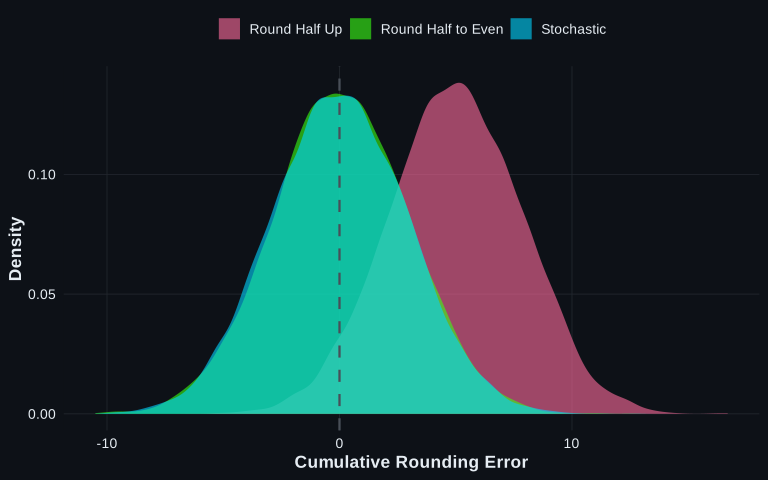
Distribution of cumulative rounding errors across 10,000 simulations. Each simulation rounds 100 random numbers (to one decimal place) and calculates the total error.
The result is clear. The “round half up” method produces errors consistently shifted to the positive side, meaning it systematically overshoots the true sum. Both “round half to even” and “stochastic” rounding produce errors centered at zero, eliminating bias. The three methods only differ in how they handle .5 values; for all other values, they round identically. Since only about 10% of our simulated numbers end in .5, the distributions for “round half to even” and “stochastic” appear similar. Eliminating bias in just the .5 case is enough to center the overall error distribution at zero.
A Broader View: Other Rounding Strategies
While Banker’s rounding is the standard for technical work due to its low bias, other rounding methods exist.
Rounding Down: Flooring vs. Truncation
These methods involve removing digits beyond the desired precision.
Truncation (Rounding Toward Zero) is the simplest method. It involves simply chopping off the extra digits. This method always moves the number’s magnitude closer to zero. A real-world example is how we state our age; a person who is 35 years and 11 months old is still said to be 35. Truncation is common in computer programming, especially in integer division, where any fractional part is discarded.
- 3.8 → 3
- −3.8 → −3
Flooring always rounds to the nearest integer in the negative direction (toward −∞). While it behaves like truncation for positive numbers, it behaves differently for negative numbers.
- 3.8 → 3
- −3.8 → −4
Rounding Up (Ceiling)
As its name suggests, this is the direct opposite of flooring. If there are any non-zero digits to be dropped, the last remaining digit is always rounded up to the next integer in the positive direction (toward +∞). This method is used in situations where you must ensure you have enough of something. For instance, if calculations show you need 4.2 gallons of paint for a project, you must buy 5 gallons. If you need to order buses for 101 people and each bus holds 50, you must order 3 buses. In these cases, rounding down would result in a shortage.
Rounding Away from Zero
This method always increases the number’s absolute value. It matters in financial and computational systems where positive and negative values must be handled consistently.
- 3.2 → 4
- −3.2 → −4