Electromagnetic Radiation
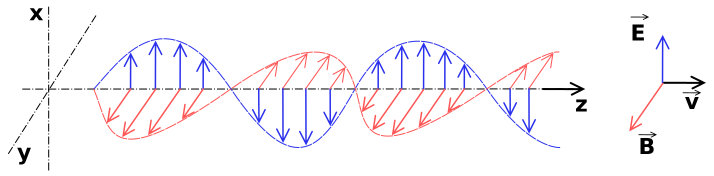
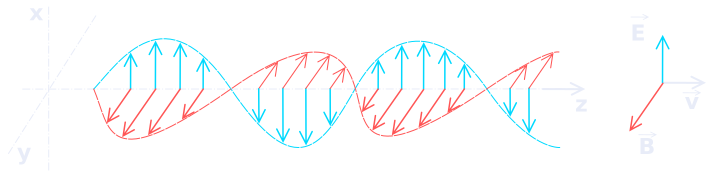
Electromagnetic radiation (i.e. light) is a form of energy that is produced by the movement of electrically charged particles through space and was an essential tool to advancing knowledge of the atom. The movement of these particles creates two propagating, orthogonal, oscillating fields - an electric field and a magnetic field, in the form of waves travelling at the speed of light. Sound waves are oscillations in air pressure. Water waves are oscillations in water height. Electromagnetic waves are oscillations in electric and magnetic fields.

Properties of Waves
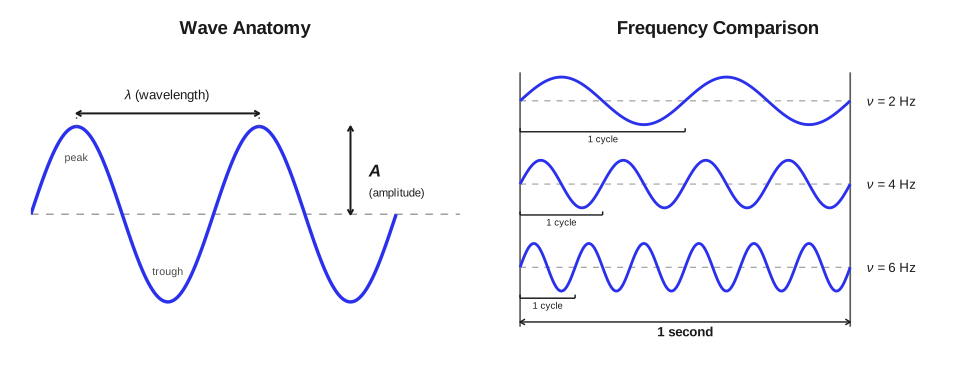
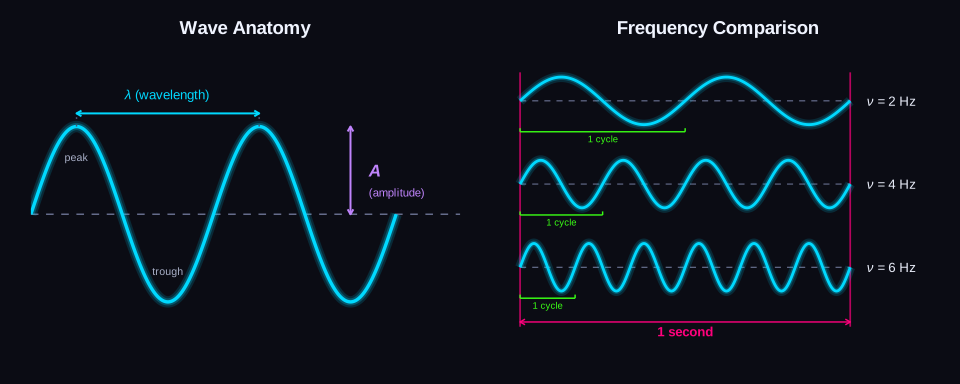
Waves are characterized by
- Wavelength (λ) - the distance between two given points on neighboring wave cycles (SI unit: meter)
- Frequency (ν) - the number of waves that pass through a given point in a given amount of time; called hertz (Hz) in cycles or oscillations per second (s–1)
- Amplitude (A) - the maximum height of the wave (SI unit: meter)
Amplitude describes the height of a wave, but when we talk about the “brightness” of light, we typically mean intensity: the power delivered per unit area (measured in W m−2).
Intensity is proportional to the square of amplitude:
\[I \propto A^2\]
Doubling a wave’s amplitude doesn’t double the intensity; it quadruples it. This relationship will become important when we discuss the photoelectric effect.
Speed of Light
The wavelength (λ) and frequency (ν) of a wave are related to the speed (c) at which the wave travels.
\[c = \lambda \nu\]
Notice that wavelength and frequency are inversely proportional (i.e. if wavelength increases, frequency decreases, and vice-versa). This relationship becomes crucial when we ask: how much energy does light of a given frequency carry? The answer, as we’ll see in the next section, involves a revolutionary constant that changed physics forever.
The “two-way” speed of electromagnetic radiation (e.g. light) in a vacuum (c0) is an average speed measured to be
\[ \begin{align*} c_0 &= 2.997~924~58 \times 10^{8}~\mathrm{m~s^{-1}} \\[1.5ex] &\approx 2.998 \times 10^{8}~\mathrm{m~s^{-1}} \end{align*} \]
This speed is approximately 186 411 miles per second. This value is a fundamental constant of nature, the same for all observers regardless of their motion or the motion of the light source.
See the Veritasium video on Why No One Has Measured The Speed of Light.
We will use the speed of light in a vacuum c0 throughout these notes and it will be denoted simply as c with a quantity of 2.998 ×10⁸ m s–1.
Wave Interference
When two waves meet, they combine to form a new wave pattern. This phenomenon is called interference. The result depends on how the waves align when they overlap.
Constructive interference occurs when waves are in phase—their crests align with crests and troughs align with troughs. The waves reinforce each other, producing a combined wave with larger amplitude. If two identical waves meet perfectly in phase, the resulting amplitude doubles.
Destructive interference occurs when waves are out of phase—the crest of one wave aligns with the trough of another. The waves cancel each other, producing a combined wave with smaller amplitude. If two identical waves meet perfectly out of phase (shifted by half a wavelength), they cancel completely and the amplitude becomes zero.
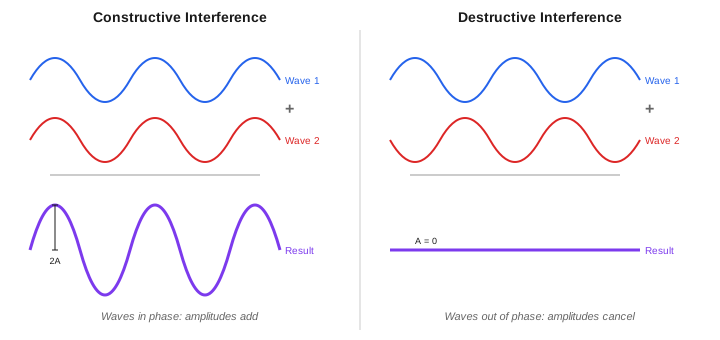
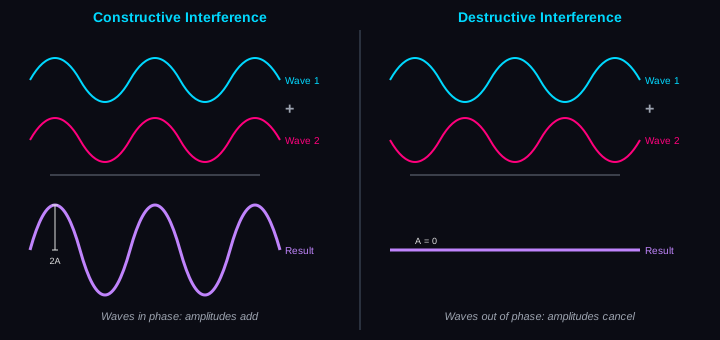
Interference is a defining characteristic of waves. Particles do not exhibit interference. Two baseballs colliding don’t reinforce or cancel each other. When we observe interference, we know we’re dealing with wave behavior. This interference effect is central to the double-slit experiment we’ll encounter when examining the nature of light and matter.
The Electromagnetic Spectrum
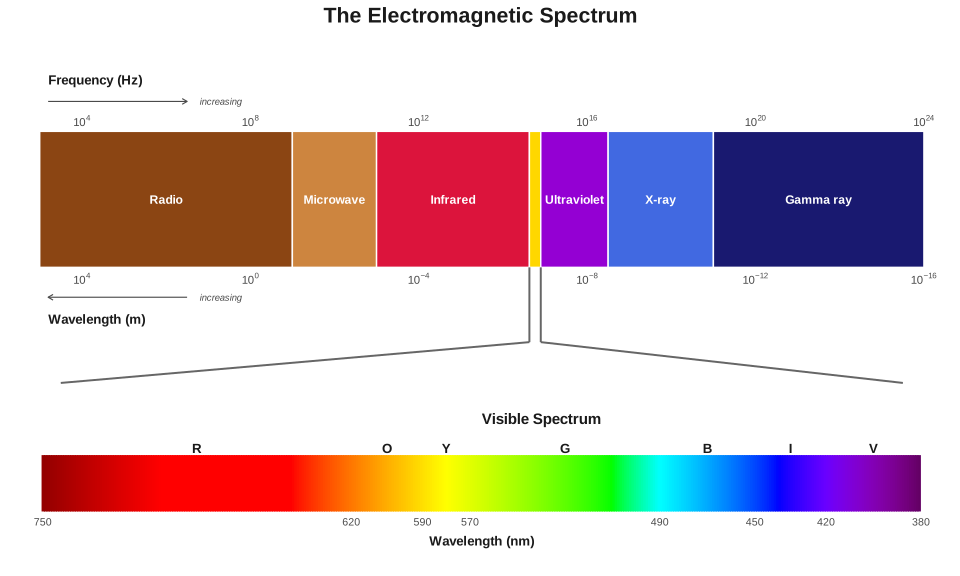
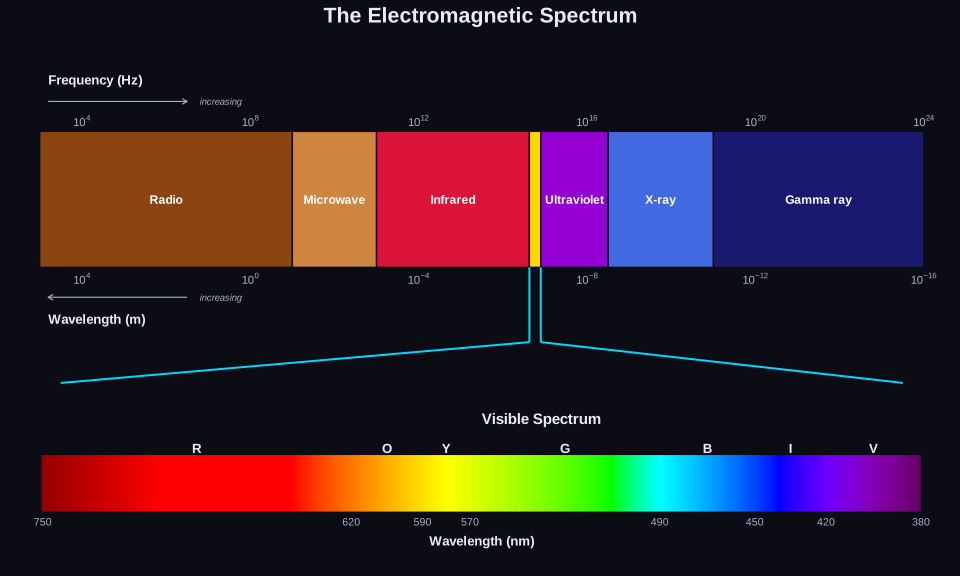
Whether radio waves or gamma rays, all electromagnetic radiation travels at the same speed c. What differs is frequency, and as we’ll see, energy.
Electromagnetic radiation is categorized based on ranges of wavelengths.
Practice
An internet router operates on a 5.0 GHz WiFi network frequency. What is the wavelength (in m) of this light?
Solution
\[ \begin{align*} c &= \lambda \nu \longrightarrow \\[1.5ex] \lambda &= \dfrac{c}{\nu} \\[1.5ex] &= \dfrac{2.998\times 10^{8}~\mathrm{m~s^{-1}}} {5.0~\mathrm{GHz} \left ( \dfrac{10^9~\mathrm{Hz}}{\mathrm{GHz}} \right )} \\[1.5ex] &= \dfrac{2.998\times 10^{8}~\mathrm{m~s^{-1}}} {5.0\times 10^{9}~\mathrm{Hz}} \\[1.5ex] &= \dfrac{2.998\times 10^{8}~\mathrm{m~s^{-1}}} {5.0\times 10^{9}~\mathrm{s^{-1}}} \\[1.5ex] &= 0.05\bar{9}96~\mathrm{m} \\[1.5ex] &= 0.060~\mathrm{m} \end{align*} \]
Practice
Amplitude modulation (AM) radio operates in a 540-1 700 kHz frequency range whereas frequency modulation (FM) radio operates in the very high frequency (VHF) range of 87.5-108.0 MHz.
What is the wavelength (in m) of AM radio if tuned to 1 100. kHz and the wavelength (in m) of FM radio if tuned to 105.9 MHz? Which radio frequency has a shorter wavelength?
Solution
AM Radio at 1 100 kHz
\[ \begin{align*} c &= \lambda \nu \longrightarrow \\[1.5ex] \lambda &= \dfrac{c}{\nu} \\[1.5ex] &= \dfrac{2.998\times 10^{8}~\mathrm{m~s^{-1}}} {1~100.~\mathrm{kHz} \left ( \dfrac{10^3~\mathrm{Hz}}{\mathrm{kHz}} \right )} \\[1.5ex] &= \dfrac{2.998\times 10^{8}~\mathrm{m~s^{-1}}} {1.10\bar{0}0\times 10^{6}~\mathrm{Hz}} \\[1.5ex] &= \dfrac{2.998\times 10^{8}~\mathrm{m~s^{-1}}} {1.10\bar{0}0\times 10^{6}~\mathrm{s^{-1}}} \\[1.5ex] &= 272.\bar{5}4~\mathrm{m} \\[1.5ex] &= 272.5~\mathrm{m} \end{align*} \]
FM Radio at 105.9 MHz
\[ \begin{align*} c &= \lambda \nu \longrightarrow \\[1.5ex] \lambda &= \dfrac{c}{\nu} \\[1.5ex] &= \dfrac{2.998\times 10^{8}~\mathrm{m~s^{-1}}} {105.9~\mathrm{MHz} \left ( \dfrac{10^6~\mathrm{Hz}}{\mathrm{MHz}} \right )} \\[1.5ex] &= \dfrac{2.998\times 10^{8}~\mathrm{m~s^{-1}}} {1.05\bar{9}0\times 10^{8}~\mathrm{Hz}} \\[1.5ex] &= \dfrac{2.998\times 10^{8}~\mathrm{m~s^{-1}}} {1.05\bar{9}0\times 10^{8}~\mathrm{s^{-1}}} \\[1.5ex] &= 2.83\bar{0}9~\mathrm{m} \\[1.5ex] &= 2.831~\mathrm{m} \end{align*} \]
FM radio has a shorter wavelength.
Practice
Which has more energy: red light or violet light? Use wave properties to explain your reasoning.
Solution
From the electromagnetic spectrum, violet light has a shorter wavelength (around 400 nm) than red light (around 700 nm).
Since wavelength and frequency are inversely related (\(c = \lambda \nu\)), shorter wavelength means higher frequency:
\[\nu = \frac{c}{\lambda}\]
A smaller \(\lambda\) gives a larger \(\nu\). Therefore, violet light has higher frequency than red light.
As we’ll see in the next section, the energy of light is directly proportional to its frequency. Higher frequency means higher energy.
Violet light has more energy than red light.
This is why ultraviolet light (even shorter wavelength than violet) can cause sunburn while infrared light (longer wavelength than red) simply feels warm.
The wave model of light successfully describes phenomena like diffraction, interference, and the relationship between wavelength and frequency. But when 19th-century physicists tried to use this model to predict how heated objects emit light, they encountered a crisis that required abandoning a core assumption about how energy works.