Foundations of Chemistry: Matter, Energy, and Measurement
What is Chemistry?
Chemistry is the central science. At its heart, it is the study of matter, the physical substance of the universe, and the changes it undergoes. Chemists seek to understand what matter is made of, how its structure determines its behavior, and how it can be transformed into new substances. From the air we breathe to the complex reactions that power life itself, chemistry provides the fundamental language for describing our physical world.
The Fundamental Laws of Chemical Change
In the late 18th and early 19th centuries, chemists like Antoine Lavoisier, Joseph Proust, and John Dalton conducted experiments that revealed a set of powerful, unbreakable rules governing how matter and energy behave. These fundamental laws are the quantitative foundation of modern chemistry and provided the first strong evidence for the existence of atoms.
The Law of Conservation of Mass
Formulated by Antoine Lavoisier in 1789, the Law of Conservation of Mass is the cornerstone of all chemical calculations. It states that:
In any chemical reaction or physical change that takes place in a closed system, mass is neither created nor destroyed.
This means that the total mass of all substances present before a change (the reactants) must be exactly equal to the total mass of all substances present after the change (the products). Atoms are not created or destroyed in a chemical reaction; they are simply rearranged to form new substances.
The Law of Definite Proportions
The French chemist Joseph Proust formulated a second fundamental principle around 1798. The Law of Definite Proportions, also known as the Law of Constant Composition, states that:
A given chemical compound always contains its component elements in a fixed ratio by mass, regardless of its source or method of preparation.
This law established that a compound is not a random mixture, but a substance with a specific, unchangeable composition. For example, any sample of pure water is always composed of 88.8% oxygen and 11.2% hydrogen by mass.
Conceptual Example: The Composition of Water
Let’s analyze the composition of a 100.0 g sample of pure water. Through experimentation, we would find that this sample contains:
- 88.8 g of Oxygen (O)
- 11.2 g of Hydrogen (H)
The mass ratio of oxygen to hydrogen is: \[ \frac{\text{mass of oxygen}}{\text{mass of hydrogen}} = \frac{88.8~\mathrm{g}}{11.2~\mathrm{g}} \approx 7.9 \] The Law of Definite Proportions states that this mass ratio of approximately 7.9-to-1 is a fundamental property of water. Every sample of pure water, no matter its size, will have this same ratio of masses between its constituent elements.
Quantitative Example: Analyzing Two Samples of Iron Sulfide
A chemist analyzes two different samples of iron sulfide.
- Sample 1: Has a total mass of 16.0 g and is found to contain 10.2 g of iron.
- Sample 2: Has a total mass of 25.0 g and is found to contain 15.9 g of iron.
Are these two samples the same compound?
To find out, we must calculate the mass percentage of iron in each sample. If the mass percentages are the same, then the samples obey the Law of Definite Proportions and are the same compound.
Calculation for Sample 1: \[ \begin{align*} \%\,\mathrm{Fe} &= \frac{m(\mathrm{Fe})}{m(\mathrm{Total})} \times 100~\% \\[1.5ex] &= \left( \frac{10.\bar{2}~\mathrm{g}}{16.\bar{0}~\mathrm{g}} \right) \times 100~\% \\[1.5ex] &= 63.7\bar{5}0~\% \\[1.5ex] &= 63.8~\% \end{align*} \]
Calculation for Sample 2: \[ \begin{align*} \%\,\mathrm{Fe} &= \frac{m(\mathrm{Fe})}{m(\mathrm{Total})} \times 100~\% \\[1.5ex] &= \left( \frac{15.\bar{9}~\mathrm{g}}{25.\bar{0}~\mathrm{g}} \right) \times 100~\% \\[1.5ex] &= 63.\bar{6}00~\% \\[1.5ex] &= 63.6~\% \end{align*} \] Within the bounds of experimental uncertainty, the mass percentages are effectively the same (~63.7%). Therefore, we can conclude that both samples are the same compound (likely iron(II) sulfide, FeS).
This law was a crucial step on the path to John Dalton’s atomic theory. The observation that elements always combine in fixed mass ratios strongly implied that they were composed of discrete, fundamental particles (atoms), each with its own characteristic mass.
The Law of Multiple Proportions
This question was answered by John Dalton around 1803 with his Law of Multiple Proportions. The law states that:
If two elements (A and B) can combine to form more than one compound, the masses of B that can combine with a fixed mass of A are in a ratio of small whole numbers.
This law, while a bit more complex, reveals a deep, underlying simplicity in the way elements combine. Let’s break it down with a classic example.
Example: The Oxides of Carbon
Carbon and oxygen can react to form two different, well-known compounds: carbon monoxide (CO) and carbon dioxide (CO2). Let’s analyze their compositions.
- Sample 1 (Carbon Monoxide): A 10.0 g sample is found to contain 4.29 g of carbon and 5.71 g of oxygen.
- Sample 2 (Carbon Dioxide): A 10.0 g sample is found to contain 2.73 g of carbon and 7.27 g of oxygen.
To see the law in action, we must first fix the mass of one of the elements. Let’s calculate the mass of oxygen that combines with a fixed mass of 1.00 g of carbon in each compound.
1. For Carbon Monoxide: \[ \text{mass ratio} = \frac{\text{mass of oxygen}}{\text{mass of carbon}} = \frac{5.71~\mathrm{g}}{4.29~\mathrm{g}} = 1.33 \] This tells us that in carbon monoxide, 1.33 g of oxygen combines with every 1.00 g of carbon.
2. For Carbon Dioxide: \[ \text{mass ratio} = \frac{\text{mass of oxygen}}{\text{mass of carbon}} = \frac{7.27~\mathrm{g}}{2.73~\mathrm{g}} = 2.66 \] This tells us that in carbon dioxide, 2.66 g of oxygen combines with every 1.00 g of carbon.
3. Find the Ratio of the Oxygen Masses:
Now, we compare the mass of oxygen that combines with our fixed mass of carbon in the two different compounds. \[ \frac{\text{mass of O in carbon dioxide}}{\text{mass of O in carbon monoxide}} = \frac{2.66~\mathrm{g}}{1.33~\mathrm{g}} = 2 \] The result is a simple, whole number: 2. This means that for a fixed amount of carbon, the amount of oxygen in carbon dioxide is exactly twice the amount of oxygen in carbon monoxide. The masses are in a small whole-number ratio (2:1).
This observation was revolutionary. The fact that elements combine in these discrete, whole-number ratios was the strongest evidence yet that matter must be composed of fundamental, indivisible particles (atoms). It’s easy to see how one carbon atom could combine with either one oxygen atom (CO) or two oxygen atoms (CO2), but it’s very difficult to explain a simple 2:1 mass ratio without the concept of atoms.
The Law of Conservation of Energy
A parallel principle governs energy. The Law of Conservation of Energy, also known as the First Law of Thermodynamics, states that:
Energy can be converted from one form to another, but it cannot be created or destroyed.
Energy can be transformed between many forms, such as the chemical energy stored in bonds, heat, or light. In any process, the total energy of the universe remains constant. This law is the foundation of thermochemistry, a topic we will explore in detail in a later chapter.
The Scientific Method: A Framework for Inquiry
Chemistry is not a collection of isolated facts; it is a dynamic process of discovery. The framework that guides this process is the scientific method. It is not a rigid, linear checklist but a flexible and iterative cycle of observation, explanation, and testing.
1. Observation and Questioning
The process begins with an observation of a phenomenon. This can be a direct sensory experience or a result from a previous experiment. This observation leads to a question.
- Observation: An iron nail left outside becomes coated in a reddish-brown, flaky substance.
- Question: What is this substance, and why does it form on the iron?
2. Hypothesis
A hypothesis is a tentative, testable, and falsifiable explanation for the observation. It is not a wild guess but an educated proposal based on existing knowledge.
- Hypothesis: “If rust is a chemical reaction between iron and oxygen from the air, then an iron nail sealed in a container with all the oxygen removed should not rust.”
3. Experimentation
An experiment is a controlled procedure designed to test the hypothesis. It typically involves altering one condition (independent variable) to observe its effect on another (dependent variable), while keeping all other conditions constant (controlled variables).
- Experiment: Place one iron nail in an open beaker of water (the control group). Place a second, identical nail in a beaker of water inside a vacuum chamber where all the air has been removed (the experimental group). Observe both nails for several days.
4. Analysis and Conclusion
After the experiment, the data is collected and analyzed. The scientist then draws a conclusion about whether the results support or refute the hypothesis.
- Analysis: The nail in the open beaker rusted. The nail in the vacuum chamber did not.
- Conclusion: The results support the hypothesis that oxygen is required for iron to rust.
5. Iteration and the Development of Scientific Knowledge
The scientific method is a powerful cycle for generating reliable knowledge. The analysis of repeated experiments leads to two distinct but complementary types of scientific principles: Laws and Theories.
Formation of a Scientific Law: If countless experiments consistently reveal a reproducible pattern, this pattern can be summarized as a scientific law. A law is a concise description of what happens. The work of Lavoisier, for example, led to the Law of Conservation of Mass.
Formation of a Scientific Theory: A hypothesis that is repeatedly supported by a vast body of evidence can be expanded into a scientific theory. A theory is a comprehensive framework that explains why the observations and laws occur. The atomic hypothesis, supported by the Laws of Chemical Combination, matured into the foundational Atomic Theory.
The results are communicated to the broader scientific community, typically through peer-reviewed publications, where other scientists can scrutinize, replicate, and build upon the work.
NoteTheory vs. Law: A Critical Distinction
Confusing a scientific theory with a scientific law is one of the most common misconceptions.
Scientific Law
A law describes a consistent, observable phenomenon. It is a summary of experimental data.
The Law of Universal Gravitation describes the mathematical relationship of the gravitational force between two objects, but it does not explain what gravity is.
Scientific Theory
A theory explains why or how a phenomenon occurs. It is an explanatory framework.
Einstein’s Theory of General Relativity provides a comprehensive explanation for why gravity exists (as a curvature of spacetime), and in doing so, it also explains the Law of Universal Gravitation.
The Takeaway: A law describes what happens; a theory explains why it happens.
Accuracy vs. Precision: The Cornerstones of Measurement
The scientific method relies on collecting high-quality data. To properly interpret this data, we must describe its reliability using two critical concepts: accuracy and precision.
- Accuracy refers to how close a measurement is to the true or accepted value.
- Precision refers to how close a series of measurements are to one another.
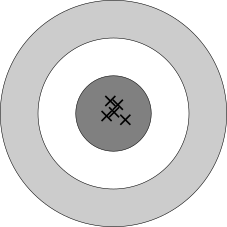
The classic analogy is a set of darts thrown at a target, where the bullseye is the “true value.”
High Accuracy, High Precision
The darts are clustered tightly together and centered on the bullseye. This is the ideal result, representing a well-calibrated instrument and good technique.
Low Accuracy, High Precision
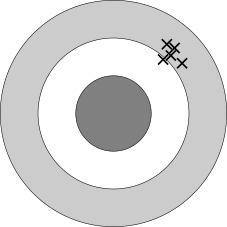
The darts are clustered tightly together but are far from the bullseye. This indicates good reproducibility but a systematic error, such as a miscalibrated balance that consistently reads 0.5 g too high.
High Accuracy, Low Precision
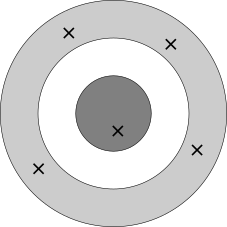
The darts are scattered, but their average position is on the bullseye. This suggests random error, where measurements fluctuate but center on the correct value. This might result from limitations of the instrument or variations in reading it.
Low Accuracy, Low Precision
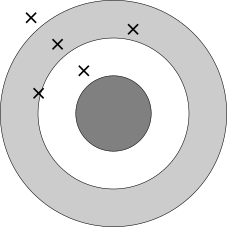
The darts are scattered all over the board and are not centered on the bullseye. This represents the worst-case scenario, indicating both random and systematic errors. The data is neither reproducible nor correct.
In any scientific endeavor, our goal is to achieve both high accuracy and high precision. Understanding the difference allows us to diagnose problems in our experimental methods and have confidence in our results.