boyleParams = ({
  pMin: 1.00, pMax: 6.00, pDefault: 2.00, pStep: 0.01,
  snapTarget: 2.00, snapThreshold: 0.06,
  nRT: 1.000 * 0.08206 * 298.15,  // 24.466 L·atm (1 mol, 298 K)
})

mutable boyleDarkMode = document.documentElement.getAttribute('data-bs-theme') === 'dark'
  || document.body.classList.contains('quarto-dark')

boyleThemeObserver = {
  const check = () => {
    const dark = document.documentElement.getAttribute('data-bs-theme') === 'dark'
      || document.body.classList.contains('quarto-dark');
    if (dark !== mutable boyleDarkMode) mutable boyleDarkMode = dark;
  };
  const obs = new MutationObserver(check);
  obs.observe(document.documentElement, {attributes: true, attributeFilter: ['data-bs-theme']});
  obs.observe(document.body, {attributes: true, attributeFilter: ['class']});
  invalidation.then(() => obs.disconnect());
}The Gas Laws
Boyle’s law, Charles’s law, Gay-Lussac’s law, Avogadro’s law, and the combined gas law. How pressure, volume, temperature, and amount of gas are related.
Gases are compressible. Unlike solids and liquids, a gas sample changes its volume a great deal when the pressure or temperature changes, and its pressure shifts when forced into a smaller container or heated. Four macroscopic variables describe the state of a gas: pressure (p), volume (V), temperature (T), and amount (n, in moles). The gas laws are the experimental relationships among these four variables, found between 1662 and 1811. Each is a limiting law: exact only as the pressure approaches zero, and followed closely at everyday pressures and temperatures, where real gases behave nearly ideally.
ImportantTemperature in Gas Calculations
All gas law equations require absolute temperature in kelvin (K). A temperature of 0 °C is 273.15 K, far above the zero of the absolute scale. Using Celsius in a gas law equation produces wrong answers because ratios like T2/T1 are meaningless when the zero point is arbitrary.
To convert, with t the Celsius value:
\[ T \,/\, \mathrm{K} = t \,/\, ^\circ\mathrm{C} + 273.15 \]
Boyle’s Law: Pressure and Volume
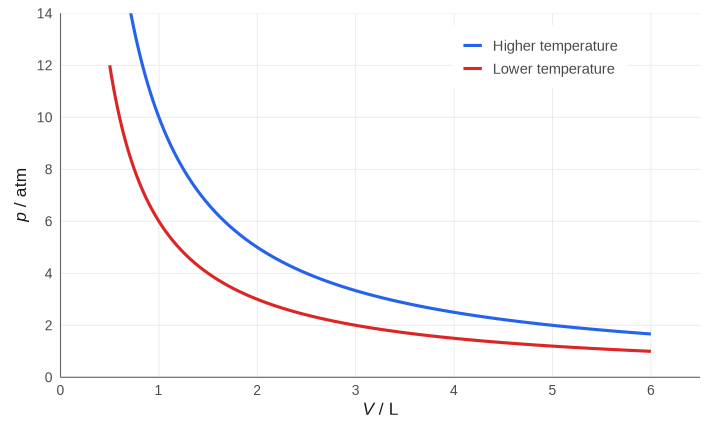
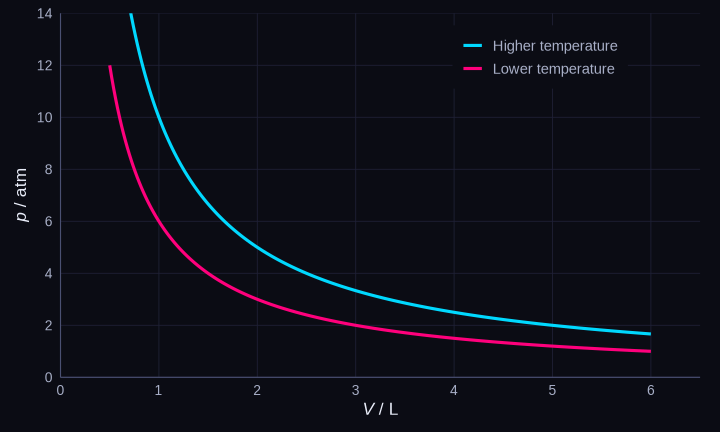
In 1662, Robert Boyle published experiments showing that the volume of a trapped gas decreases as the pressure on it increases, provided the temperature and amount of gas remain constant.

Robert Boyle: Anglo-Irish natural philosopher, chemist, physicist, alchemist and inventor (1627–1691) (Source: Wikipedia)
The relationship is an inverse proportion:
\[ p \propto \dfrac{1}{V} \qquad (\text{constant } T, n) \]
This means the product pV is constant for a given sample of gas at fixed temperature:
\[ p_1 V_1 = p_2 V_2 \]
At constant temperature and amount of gas, doubling the pressure halves the volume. Tripling the pressure reduces the volume to one-third. The relationship holds for any gas at moderate pressures and temperatures where the gas behaves approximately ideally.
Example: A gas sample occupies 2.50 L at 1.00 atm. The gas is compressed at constant temperature until the pressure reaches 3.50 atm. What is the new volume (in L)?
\[ \begin{align*} p_1 V_1 &= p_2 V_2 \longrightarrow \\[1.5ex] V_2 &= \dfrac{p_1 V_1}{p_2} \\[1.5ex] &= \dfrac{(1.0\bar{0}~\mathrm{atm})(2.5\bar{0}~\mathrm{L})}{3.5\bar{0}~\mathrm{atm}} \\[1.5ex] &= 0.71\bar{4}28~\mathrm{L} \\[1.5ex] &= 0.714~\mathrm{L} \end{align*} \]
The pressure increased by a factor of 3.5 (1.00 → 3.50 atm), so the volume fell to 1/3.5 of its initial value, consistent with an inverse relationship.
Charles’s Law: Volume and Temperature
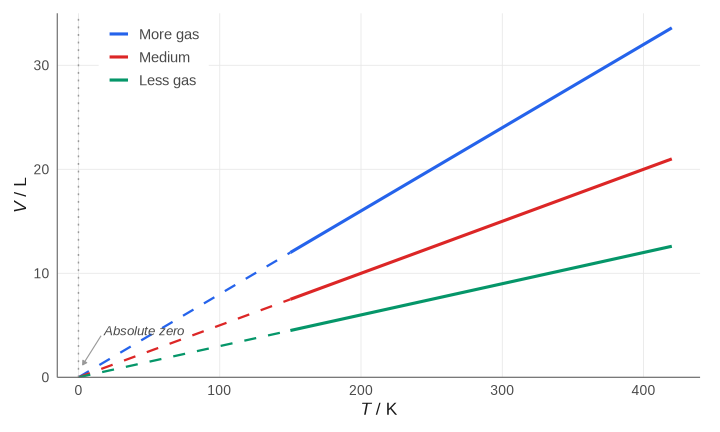
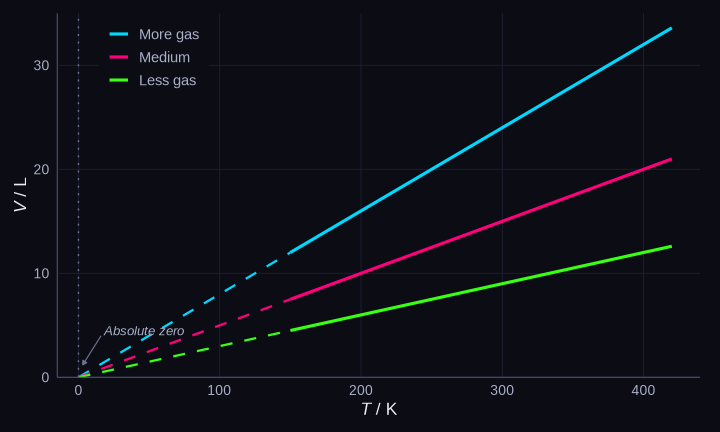
In the 1780s, Jacques Charles found that the volume of a gas increases linearly with temperature when the pressure and amount of gas are held constant.

Jacques Charles: French inventor, scientist, and balloonist (1746–1823) (Source: Wikipedia)
Expressed as a proportion:
\[ V \propto T \qquad (\text{constant } p, n) \]
The ratio V/T is constant:
\[ \dfrac{V_1}{T_1} = \dfrac{V_2}{T_2} \]
A gas that occupies 1 L at 300 K will occupy 2 L at 600 K (at the same pressure). This linear relationship holds only when temperature is measured in kelvin. Doubling the Celsius temperature does not double the volume: warming a gas from 20 °C to 40 °C takes it from 293 K to 313 K, an increase of only about 7 %, not 100 %. Geometrically, a proportionality is a straight line through the origin, and the volume–temperature line reaches zero volume at −273.15 °C. Only the Kelvin scale, whose zero sits at that point, puts the line through the origin and makes V proportional to T.
NoteAbsolute Zero
If the volume of a gas decreases linearly with temperature, extrapolation predicts that the volume would reach zero at −273.15 °C (0 K). This temperature, absolute zero, is the lower limit of the kelvin scale. No gas actually reaches zero volume because all real gases condense into liquids or solids before reaching 0 K. The extrapolation does, however, provide the physical basis for the absolute temperature scale.
Example: A balloon filled with helium has a volume of 1.25 L at 22.0 °C. The balloon is heated to 78.0 °C at constant pressure. What is the new volume (in L)?
Convert temperatures to kelvin:
- T1 / K = 22.0 + 273.15 = 295.5
- T2 / K = 78.0 + 273.15 = 351.5
\[ \begin{align*} \dfrac{V_1}{T_1} &= \dfrac{V_2}{T_2} \longrightarrow \\[1.5ex] V_2 &= V_1 \dfrac{T_2}{T_1} \\[1.5ex] &= (1.2\bar{5}~\mathrm{L}) \left(\dfrac{351.\bar{1}5~\mathrm{K}}{295.\bar{1}5~\mathrm{K}}\right) \\[1.5ex] &= 1.4\bar{8}71~\mathrm{L} \\[1.5ex] &= 1.49~\mathrm{L} \end{align*} \]
The volume increases because the balloon is held at constant pressure: warming the gas raises its pressure momentarily, so the balloon expands until the inside pressure again matches the surrounding atmosphere.
Gay-Lussac’s Law: Pressure and Temperature
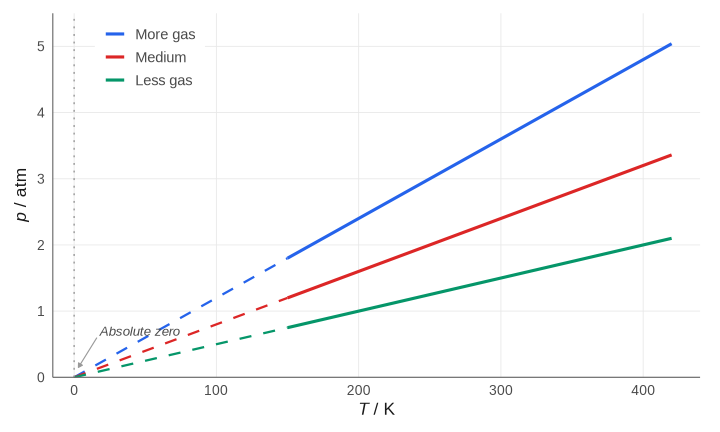
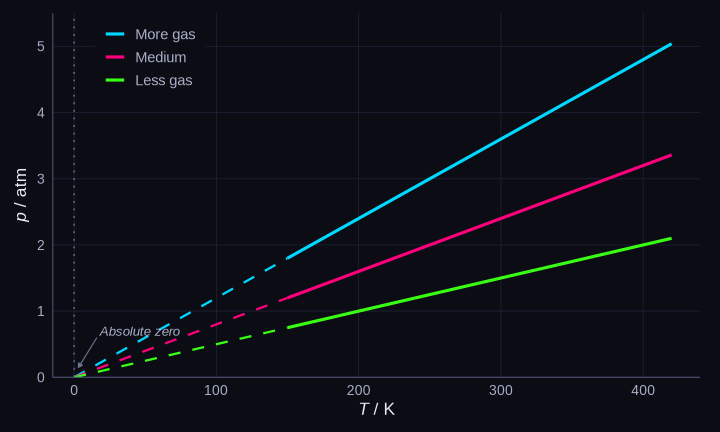
Joseph Louis Gay-Lussac showed that the pressure of a gas at constant volume is directly proportional to its absolute temperature:

Joseph Louis Gay-Lussac: French chemist and physicist (1778–1850) (Source: Wikipedia)
\[ p \propto T \qquad (\text{constant } V, n) \]
\[ \dfrac{p_1}{T_1} = \dfrac{p_2}{T_2} \]
This relationship explains why aerosol cans carry warnings against heating: as temperature rises, pressure rises in a rigid container, and the can may rupture if the pressure exceeds what the walls can withstand. Like Charles’s law, the relationship is linear through the origin.
Although the law carries Gay-Lussac’s name, Guillaume Amontons established the pressure–temperature relationship about a century earlier, around 1699; for this reason it is sometimes called Amontons’s law.
Example: A car tire has a pressure of 2.30 atm at 18.0 °C. After highway driving, the tire temperature rises to 42.0 °C. Assuming the tire volume does not change, what is the new pressure (in atm)?
Convert temperatures to kelvin:
- T1 / K = 18.0 + 273.15 = 291.5
- T2 / K = 42.0 + 273.15 = 315.5
\[ \begin{align*} \dfrac{p_1}{T_1} &= \dfrac{p_2}{T_2} \longrightarrow \\[1.5ex] p_2 &= p_1 \dfrac{T_2}{T_1} \\[1.5ex] &= (2.3\bar{0}~\mathrm{atm}) \left(\dfrac{315.\bar{1}5~\mathrm{K}}{291.\bar{1}5~\mathrm{K}}\right) \\[1.5ex] &= 2.4\bar{8}95~\mathrm{atm} \\[1.5ex] &= 2.49~\mathrm{atm} \end{align*} \]
The pressure rises by about 8 %, reflecting the modest temperature increase (315/291 ≈ 1.08).
NoteGoing Deeper: Reading a Tire Gauge
The pressures in a gas law must be absolute: the whole pressure of the gas, measured from zero. A tire gauge does not read that. It reads gauge pressure, the pressure above the atmosphere’s, so a flat tire reads 0 psi even though the air inside it is at about 14.7 psi. The example above gives the tire’s pressure as an absolute value. A real tire problem starts from a gauge reading, and the reading has to be converted before it goes into the gas law.
Example: A tire gauge reads 32.0 psi at 18.0 °C. After highway driving, the tire is at 42.0 °C. The atmospheric pressure is 14.7 psi, and the volume of the tire does not change. What does the gauge read now?
Convert the reading to absolute pressure:
\[ \begin{align*} p_1 &= p_{\mathrm{gauge}} + p_{\mathrm{atm}} \\[1.5ex] &= 32.\bar{0}~\mathrm{psi} + 14.\bar{7}~\mathrm{psi} \\[1.5ex] &= 46.\bar{7}~\mathrm{psi} \end{align*} \]
Apply Gay-Lussac’s law to the absolute pressure, with the temperatures in kelvin as in the example above:
\[ \begin{align*} p_2 &= p_1 \dfrac{T_2}{T_1} \\[1.5ex] &= (46.\bar{7}~\mathrm{psi}) \left(\dfrac{315.\bar{1}5~\mathrm{K}}{291.\bar{1}5~\mathrm{K}}\right) \\[1.5ex] &= 50.\bar{5}49~\mathrm{psi} \end{align*} \]
Subtract the atmosphere to get back to what the gauge shows:
\[ \begin{align*} p_{\mathrm{gauge}} &= p_2 - p_{\mathrm{atm}} \\[1.5ex] &= 50.\bar{5}49~\mathrm{psi} - 14.\bar{7}~\mathrm{psi} \\[1.5ex] &= 35.\bar{8}49~\mathrm{psi} \\[1.5ex] &= 35.8~\mathrm{psi} \end{align*} \]
The gauge reading rises from 32.0 psi to 35.8 psi. Putting the gauge reading straight into the law gives (32.0 psi)(315.15 K / 291.15 K) = 34.6 psi, more than 1 psi too low. The law applies to the absolute pressure, and a gauge reading is 14.7 psi short of it.
Avogadro’s Law: Volume and Amount
In 1811, Amedeo Avogadro proposed that equal volumes of gases at the same temperature and pressure contain equal numbers of molecules.

Amedeo Avogadro: Italian scientist (1776–1856) (Source: Wikipedia)
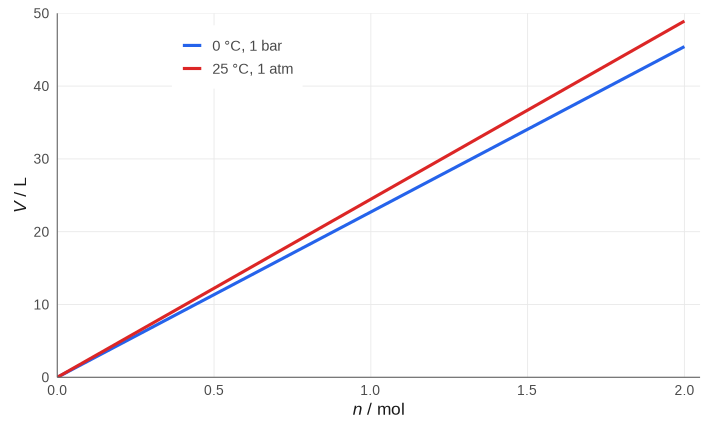
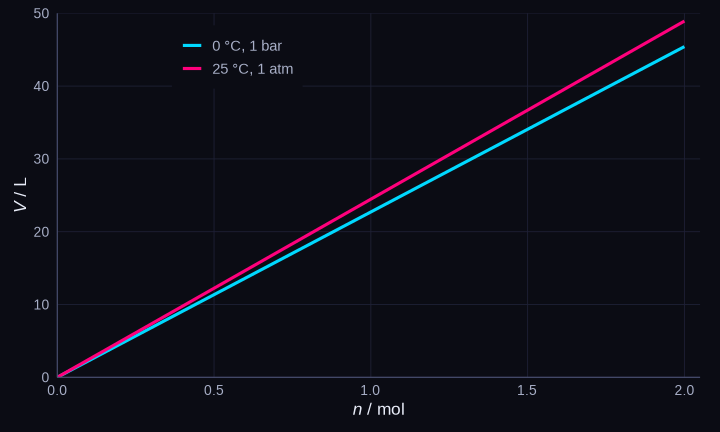
The modern statement is that volume is directly proportional to the amount of gas at constant temperature and pressure:
\[ V \propto n \qquad (\text{constant } p, T) \]
\[ \dfrac{V_1}{n_1} = \dfrac{V_2}{n_2} \]
Doubling the number of moles at the same p and T doubles the volume. The kind of gas does not matter, only the number of particles. One mole of helium at a given p and T occupies the same volume as 1 mol of nitrogen or 1 mol of carbon dioxide.
NoteStandard Temperature and Pressure (STP)
STP is 0 °C (273.15 K) and 1 bar (100 kPa). At these conditions, 1 mol of an ideal gas occupies 22.711 L. This molar volume follows from Avogadro’s law: at fixed T and p, volume depends only on the number of moles.
Many textbooks define STP using 1 atm (101.325 kPa) instead of 1 bar, giving a molar volume of 22.414 L. The two values differ by about 1.3 %, the same as the difference between the two pressure standards. When a problem says “at STP,” check which pressure standard is in use. This text follows the IUPAC convention (1 bar, adopted 1982).
The molar volume at STP is derived from pV = nRT in the ideal gas law.
Example: A balloon contains 0.500 mol of helium and occupies 12.2 L at constant temperature and pressure. An additional 0.300 mol of helium is added. What is the new volume (in L)?
\[ \begin{align*} \dfrac{V_1}{n_1} &= \dfrac{V_2}{n_2} \longrightarrow \\[1.5ex] V_2 &= V_1 \dfrac{n_2}{n_1} \\[1.5ex] &= (12.\bar{2}~\mathrm{L}) \left(\dfrac{0.80\bar{0}~\mathrm{mol}}{0.50\bar{0}~\mathrm{mol}}\right) \\[1.5ex] &= 19.\bar{5}20~\mathrm{L} \\[1.5ex] &= 19.5~\mathrm{L} \end{align*} \]
Adding 60 % more gas increases the volume by 60 %, as expected for a direct proportion.
The Combined Gas Law
Boyle’s, Charles’s, and Gay-Lussac’s laws each hold one pair of variables constant while relating the other two. Combining them yields a single equation that relates all four variables for a fixed amount of gas:
\[ \dfrac{p_1 V_1}{T_1} = \dfrac{p_2 V_2}{T_2} \]
This is the combined gas law. It reduces to any of the individual laws when the appropriate variable is held constant:
- Hold T constant (T1 = T2): Boyle’s law, p1V1 = p2V2
- Hold p constant (p1 = p2): Charles’s law, V1/T1 = V2/T2
- Hold V constant (V1 = V2): Gay-Lussac’s law, p1/T1 = p2/T2
The combined gas law is used whenever a gas changes from one set of conditions (p1, V1, T1) to another (p2, V2, T2) with the amount of gas held constant.
Example: A sealed cylinder with a movable piston holds 3.60 L of gas at 745 mmHg and 25.0 °C. The pressure on the piston is raised to 780 mmHg, and the gas is heated to 50.0 °C. What is the new volume (in L)?
Convert temperatures to kelvin:
- T1 / K = 25.0 + 273.15 = 298.5
- T2 / K = 50.0 + 273.15 = 323.5
\[ \begin{align*} \dfrac{p_1 V_1}{T_1} &= \dfrac{p_2 V_2}{T_2} \longrightarrow \\[1.5ex] V_2 &= \dfrac{p_1 V_1 T_2}{p_2 T_1} \\[1.5ex] &= \dfrac{(74\bar{5}~\mathrm{mmHg})(3.6\bar{0}~\mathrm{L})(323.\bar{1}5~\mathrm{K})}{(780.~\mathrm{mmHg})(298.\bar{1}5~\mathrm{K})} \\[1.5ex] &= 3.7\bar{2}67~\mathrm{L} \\[1.5ex] &= 3.73~\mathrm{L} \end{align*} \]
The volume increases slightly. The pressure increase (745 → 780 mmHg) tends to compress the gas, but the temperature increase (298 → 323 K) tends to expand it. The temperature ratio (323/298 ≈ 1.08) is larger than the pressure ratio (780/745 ≈ 1.05), so the gas ends up slightly larger.
If we also allow the amount of gas to vary, the combined gas law generalizes to the ideal gas law. All of these are limiting laws, exact only for an ideal gas. Real gases depart from them at high pressure and low temperature.
TipIdentifying Which Law to Use
Read the problem and identify which variables change and which are held constant. The constant variables determine the law:
- T and n constant → Boyle’s law (p and V)
- p and n constant → Charles’s law (V and T)
- V and n constant → Gay-Lussac’s law (p and T)
- p and T constant → Avogadro’s law (V and n)
- Only n constant → combined gas law (p, V, and T all change)
Key phrases: “rigid container” means constant V. “Sealed” or “fixed amount” means constant n. “At constant pressure” or “open to the atmosphere” means constant p.
Practice
A sealed, rigid steel cylinder contains nitrogen gas at 2.50 atm and 20.0 °C. The cylinder is left in direct sunlight and its temperature rises to 55.0 °C. What is the final pressure (in atm) of the nitrogen gas?
Solution
The cylinder is rigid (V is constant) and sealed (n is constant). This is Gay-Lussac’s law.
Convert temperatures to kelvin:
- T1 / K = 20.0 + 273.15 = 293.5
- T2 / K = 55.0 + 273.15 = 328.5
\[ \begin{align*} \dfrac{p_1}{T_1} &= \dfrac{p_2}{T_2} \longrightarrow \\[1.5ex] p_2 &= p_1 \dfrac{T_2}{T_1} \\[1.5ex] &= (2.5\bar{0}~\mathrm{atm}) \left(\dfrac{328.\bar{1}5~\mathrm{K}}{293.\bar{1}5~\mathrm{K}}\right) \\[1.5ex] &= 2.7\bar{9}84~\mathrm{atm} \\[1.5ex] &= 2.80~\mathrm{atm} \end{align*} \]
The pressure increases by about 12 %, consistent with the temperature ratio (328/293 ≈ 1.12).
Practice
A syringe contains 15.0 mL of air at 755 mmHg and 22.0 °C. The plunger is pushed in until the volume is 9.50 mL, and the temperature rises to 28.0 °C due to the compression. What is the final pressure (in mmHg)?
Solution
Pressure, volume and temperature all change, and n is constant. Use the combined gas law.
Convert temperatures to kelvin:
- T1 / K = 22.0 + 273.15 = 295.5
- T2 / K = 28.0 + 273.15 = 301.5
\[ \begin{align*} \dfrac{p_1 V_1}{T_1} &= \dfrac{p_2 V_2}{T_2} \longrightarrow \\[1.5ex] p_2 &= p_1 \dfrac{V_1}{V_2} \dfrac{T_2}{T_1} \\[1.5ex] &= (75\bar{5}~\mathrm{mmHg}) \left(\dfrac{15.\bar{0}~\mathrm{mL}}{9.5\bar{0}~\mathrm{mL}}\right) \left(\dfrac{301.\bar{1}5~\mathrm{K}}{295.\bar{1}5~\mathrm{K}}\right) \\[1.5ex] &= 12\bar{1}6.3~\mathrm{mmHg} \\[1.5ex] &= 1.22 \times 10^{3}~\mathrm{mmHg} \end{align*} \]
The pressure rises by a factor of about 1.6. Most of that comes from the smaller volume (15.0/9.50 ≈ 1.58), and the warmer gas adds about 2 % (301/295 ≈ 1.02).
Practice
A gas occupies 500.0 mL at 2.00 atm and 80.0 °C. It is cooled to 10.0 °C in a flexible container, and the final pressure is measured as 785 mmHg. What is the final volume (in L)?
Solution
Three variables change (p, V, T) with n constant. This is the combined gas law. The pressures are in different units and the volume must be reported in liters, so convert before substituting.
Convert units:
- p1 = 2.00 atm × (760 mmHg / 1 atm) = 1520 mmHg
- V1 = 500.0 mL × (1 L / 1000 mL) = 0.5000 L
- T1 / K = 80.0 + 273.15 = 353.5
- T2 / K = 10.0 + 273.15 = 283.5
\[ \begin{align*} \dfrac{p_1 V_1}{T_1} &= \dfrac{p_2 V_2}{T_2} \longrightarrow \\[1.5ex] V_2 &= \dfrac{p_1 V_1 T_2}{p_2 T_1} \\[1.5ex] &= \dfrac{(15\bar{2}0~\mathrm{mmHg})(0.500\bar{0}~\mathrm{L})(283.\bar{1}5~\mathrm{K})}{(78\bar{5}~\mathrm{mmHg})(353.\bar{1}5~\mathrm{K})} \\[1.5ex] &= 0.77\bar{6}24~\mathrm{L} \\[1.5ex] &= 0.776~\mathrm{L} \end{align*} \]
The pressure drop (1520 → 785 mmHg) alone would nearly double the volume. The cooling (353 → 283 K) takes back part of that, and the volume ends 55 % larger.
Summary
The Gas Laws
Four variables describe the state of a gas: pressure (p), volume (V), absolute temperature (T in K), and amount (n in mol).
The Combined Gas Law
\[ \dfrac{p_1 V_1}{T_1} = \dfrac{p_2 V_2}{T_2} \qquad (\text{constant } n) \]
All temperatures must be in kelvin. Pressure and volume may use any consistent units, provided the same unit is used for both states.