Kinetic Molecular Theory
The molecular basis of gas behavior: how pressure arises from collisions, the relationship between temperature and molecular speed, the Maxwell-Boltzmann distribution, and Graham’s law of effusion.
The ideal gas law tells us what gases do: pV = nRT. Kinetic molecular theory explains why. It models a gas as a large number of tiny particles in constant random motion and derives the macroscopic gas laws from the mechanics of molecular collisions.
The Postulates
The idea that gas pressure comes from molecular motion dates to Daniel Bernoulli (1738), but it was largely ignored for over a century. In 1857, Rudolf Clausius published a systematic treatment that formalized the assumptions below and related molecular speed to temperature. Maxwell and Boltzmann then developed the statistical framework in the 1860s and 1870s.
Kinetic molecular theory rests on five assumptions:
- A gas consists of a large number of particles in constant, random, straight-line motion.
- The volume of the individual particles is negligible compared to the volume of the container.
- Intermolecular forces between particles are negligible.
- Collisions between particles and with the walls are perfectly elastic (no energy is lost).
- The average kinetic energy of the particles is proportional to the absolute temperature.
These are idealizations. Real molecules have finite volume and do attract each other through intermolecular forces, which is why the ideal gas law fails at high pressure and low temperature. But at moderate conditions, the postulates hold well enough that the theory makes accurate, quantitative predictions about pressure, volume, and the gas laws.
Pressure from Molecular Collisions
Pressure is the force per unit area on a surface. In a gas, that force comes from molecular collisions with the walls. Consider a single molecule of mass m traveling at speed u toward a wall. It hits the wall, reverses direction, and bounces back. The momentum change in that collision is 2mu (the molecule went from +mu to −mu). If the molecule is in a box of length L, it hits the same wall every 2L/u seconds. The average force from this one molecule on one wall is:
\[ F_{\mathrm{one}} = \dfrac{\Delta(mu)}{\Delta t} = \dfrac{2mu}{2L/u} = \dfrac{mu^2}{L} \]
Summing over all N molecules and dividing by the wall area gives the pressure. Motion is shared equally among the three directions, so only one-third drives any one pair of walls, and averaging u2 over all the molecules introduces the mean-square speed:
\[ p = \dfrac{Nmu_{\mathrm{rms}}^2}{3V} \]
where urms is the root-mean-square speed. Since N = nNA and m = M/NA:
\[ pV = \dfrac{1}{3} nMu_{\mathrm{rms}}^2 \]
The mechanics give only pV = ⅓nMurms2. Reaching pV = nRT requires postulate 5, which makes the average kinetic energy proportional to T. Setting ⅓Murms2 equal to RT is the quantitative form of that postulate, and it defines the absolute temperature scale in molecular terms. Solving for the speed gives the connection between temperature and molecular speed:
\[ u_{\mathrm{rms}} = \sqrt{\dfrac{3RT}{M}} \]
Here M is the molar mass in kg mol−1, which keeps the result in m s−1.
The subscript “rms” stands for root-mean-square: square every molecular speed, take the mean, then take the square root. Squaring before averaging gives extra weight to the fastest molecules. Pressure depends on u2: the momentum transferred per collision scales with u and the collision rate also scales with u, so their product scales with u2. The RMS is therefore the average that enters the pressure equation naturally.
Temperature measures average molecular kinetic energy. From the same comparison, the average translational kinetic energy per molecule is:
\[ \overline{E}_{\mathrm{k}} = \dfrac{1}{2}mu_{\mathrm{rms}}^2 = \dfrac{3}{2}k_{\mathrm{B}}T \]
where kB = R/NA = 1.380 649 × 10−23 J K−1 is the Boltzmann constant.
Because the kinetic energy ½mu2 is linear in u2, its average over all molecules is ½m times the mean-square speed, ½murms2. The same urms2 that enters the pressure equation therefore sets the average energy.
NoteKinetic Energy and the Joule
An object of mass m moving at speed u has kinetic energy
\[ E_{\mathrm{k}} = \dfrac{1}{2}mu^2 \]
With m in kilograms and u in meters per second, the unit is
\[ (\mathrm{kg})(\mathrm{m~s^{-1}})^2 = \mathrm{kg~m^2~s^{-2}} = \mathrm{J} \]
This is the joule. A newton is the force that gives 1 kg an acceleration of 1 m s−2, so 1 N = 1 kg m s−2, and a joule is the work done by a force of 1 N over 1 m: 1 J = 1 N m = 1 kg m2 s−2. The ½ is a pure number and carries no unit.
For one N2 molecule moving at the rms speed of N2 at 25 °C, 515 m s−1 (from the table under Molecular Speeds), the mass of the molecule is the molar mass divided by the Avogadro constant:
\[ \begin{align*} m &= \dfrac{M}{N_{\mathrm{A}}} \\[1.5ex] &= \dfrac{0.0280\bar{1}~\mathrm{kg~mol^{-1}}}{6.022\,140\,76 \times 10^{23}~\mathrm{mol^{-1}}} \\[1.5ex] &= 4.65\bar{1}17 \times 10^{-26}~\mathrm{kg} \\[3ex] E_{\mathrm{k}} &= \dfrac{1}{2}mu^2 \\[1.5ex] &= \dfrac{1}{2} \left( 4.65\bar{1}17 \times 10^{-26}~\mathrm{kg} \right) \left( 51\bar{5}~\mathrm{m~s^{-1}} \right)^2 \\[1.5ex] &= 6.1\bar{6}80 \times 10^{-21}~\mathrm{kg~m^2~s^{-2}} \\[1.5ex] &= 6.17 \times 10^{-21}~\mathrm{J} \end{align*} \]
This is the (3/2)kBT of 25 °C, 6.17 × 10⁻²¹ J, worked out from the speed instead. The same units explain why M must be in kg mol−1 in urms = √(3RT/M): R is in J mol−1 K−1, so RT/M is in J kg−1 = (kg m2 s−2) kg−1 = m2 s−2, and its square root is a speed in m s−1. With M in g mol−1, the grams would not cancel the kilograms inside the joule.
The joule returns as the unit of work and energy in Work.
NoteSame Temperature, Same Energy, Different Speeds
At 25 °C, the molecules of every gas have the same average kinetic energy: (3/2)(1.381 × 10−23)(298) = 6.17 × 10⁻²¹ J, regardless of their mass. Per mole that is (3/2)RT = 3.72 kJ mol−1. Since \(\overline{E}_{\mathrm{k}} = \tfrac{1}{2}mu^2\) is the same for all gases at a given T, a molecule with twice the mass must have half the value of u2, which means it moves only 1/√2 ≈ 0.71 as fast.
NoteRecovering the Named Gas Laws
The single collision picture behind p = Nmu2rms/(3V) contains all four named gas laws. Pressure rises whenever molecules strike the walls more often or strike them harder, and urms is set by temperature alone.
- Boyle’s law (p ∝ 1/V, fixed T, n): the molecules keep the same speed, so squeezing them into less volume makes them hit the walls more often, raising the pressure.
- Charles’s law (V ∝ T, fixed p, n): heating speeds the molecules up, so each collision pushes harder. To hold the pressure steady, the volume must expand until the molecules strike each part of the wall less often, by just enough to balance the harder hits.
- Gay-Lussac’s law (p ∝ T, fixed V, n): in a sealed volume, faster molecules hit the walls both harder and more often, so the pressure climbs with temperature.
- Avogadro’s law (V ∝ n, fixed p, T): each molecule delivers the same wall collisions, so adding molecules forces the volume to grow in step to keep the pressure constant.
Molecular Speeds
Not all molecules in a gas move at the same speed. At any instant, some are fast, some are slow, and most are somewhere in between. The distribution of speeds was worked out by James Clerk Maxwell in 1860 and extended by Ludwig Boltzmann in the following decade. It was among the first physical laws stated as a probability distribution, and it underlies statistical mechanics.
Three characteristic speeds describe the distribution:
\[ \begin{align*} u_{\mathrm{mp}} &= \sqrt{\dfrac{2RT}{M}} \qquad \text{(most probable speed)} \\[1.5ex] u_{\mathrm{avg}} &= \sqrt{\dfrac{8RT}{\pi M}} \qquad \text{(mean speed)} \\[1.5ex] u_{\mathrm{rms}} &= \sqrt{\dfrac{3RT}{M}} \qquad \text{(root-mean-square speed)} \end{align*} \]
The three speeds are always ordered ump < uavg < urms. The ordering comes from the shape of the distribution: the long tail to the right (fast molecules) pulls the mean above the peak, and squaring pulls the RMS higher still. For nitrogen at 25 °C: ump = 421 m s−1, uavg = 475 m s−1, urms = 515 m s−1.
The ratios ump : uavg : urms = √2 : √(8/π) : √3 ≈ 1.00 : 1.13 : 1.22, and these ratios are the same for any gas at any temperature. In the interactive explorer below, the three dashed lines appear to spread apart at higher temperatures, but they are always the same fraction apart. The absolute gaps (in m s−1) grow with √T while the proportional spacing stays fixed.
Hydrogen molecules at room temperature travel at nearly 2 km s−1. CO2 molecules are about 22 times heavier and move about 4.7 times slower, at roughly 400 m s−1. The ratio of their speeds follows from the masses: u(H2)/u(CO2) = √(M(CO2)/M(H2)) = √(44.01/2.02) = 4.67. This ratio is the same at any temperature because T cancels in the ratio u1/u2 = √(M2/M1). H2 always moves 4.67 times faster than CO2, whether at 200 K or 2000 K.
Example: Calculate the root-mean-square speed (in m s−1) of CO2 molecules at 25.0 °C. (M(CO2) = 44.01 g mol−1 = 0.04401 kg mol−1)
\[ \begin{align*} u_{\mathrm{rms}} &= \sqrt{\dfrac{3RT}{M}} \\[1.5ex] &= \sqrt{\dfrac{3(8.3145~\mathrm{J~mol^{-1}~K^{-1}})(298.\bar{1}5~\mathrm{K})}{0.0440\bar{1}~\mathrm{kg~mol^{-1}}}} \\[1.5ex] &= \sqrt{168\,\bar{9}82~\mathrm{m^2~s^{-2}}} \\[1.5ex] &= 411.\bar{0}74~\mathrm{m~s^{-1}} \\[1.5ex] &= 411.1~\mathrm{m~s^{-1}} \end{align*} \]
This is about 1480 km h−1. For comparison, the speed of sound in air is 343 m s−1 at 20 °C and is itself temperature-dependent. Sound propagates through molecular collisions, so its speed is on the same order as the molecular speeds themselves.
The Maxwell–Boltzmann Distribution
The full speed distribution f(u) describes how molecular speeds are spread out at temperature T:
\[ f(u) = 4\pi \left(\dfrac{M}{2\pi RT}\right)^{3/2} u^2 \exp\left(-\dfrac{Mu^2}{2RT}\right) \]
The curve rises steeply from zero (few molecules are nearly stationary), peaks at ump, and has a long tail to the right (a small fraction of molecules move much faster than average). The height of the curve is a probability density, not a fraction. The fraction of molecules with speeds in a narrow interval is the area under the curve across that interval.
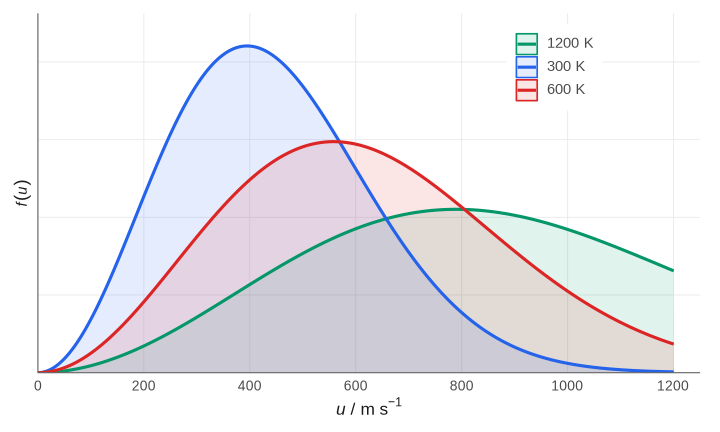
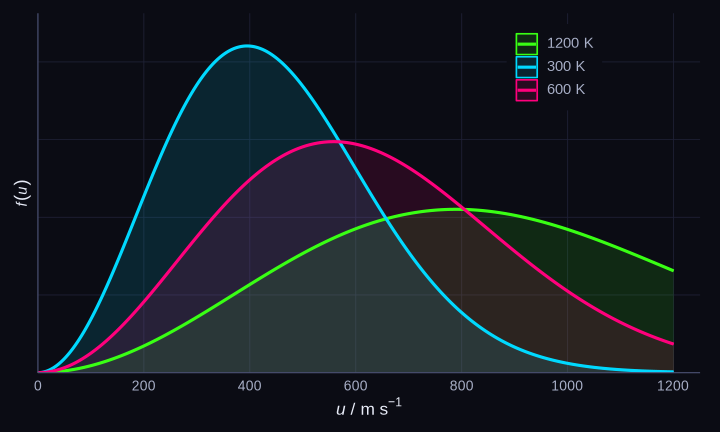
At higher temperature, the peak shifts to the right (molecules move faster on average) and the curve flattens (a wider range of speeds). The total area under each curve is 1 (every molecule has some speed).
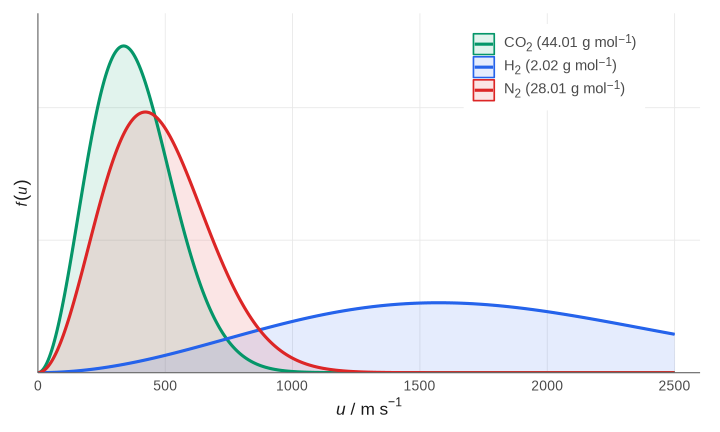
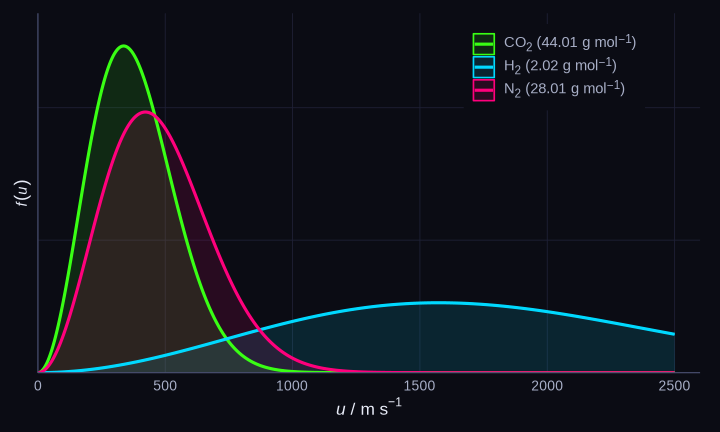
At the same temperature, lighter molecules move faster. The distributions for H2, N2, and CO2 all integrate to the same area (the whole sample, a fraction of 1), but the lighter gas spreads its probability over a much wider speed range.
Diffusion and Effusion
Diffusion is the gradual mixing of one gas through another. When a bottle of perfume is opened across a room, the scent molecules spread through the air by diffusion. The process is slow despite high molecular speeds because each molecule undergoes billions of collisions per second, following a zigzag path rather than a straight line. The average distance a molecule travels between collisions is the mean free path. For N2 at STP, the mean free path is about 60 nm, roughly 160 molecular diameters. A molecule at 500 m s−1 covers macroscopic distances quickly in a straight line, but the constant redirections from collisions make the net displacement much smaller. The mean free path scales as T/p: at lower pressure (fewer molecules per unit volume) or higher temperature, molecules travel further between collisions.
Effusion is the escape of gas molecules through a tiny hole into a vacuum or lower-pressure region. For effusion to occur cleanly (molecules passing through one at a time), the hole must be smaller than the mean free path. Effusion is simpler to analyze than diffusion because it depends only on how often molecules hit the hole, which is proportional to their speed. The full escape rate also rises with pressure and falls as √(MT) grows, but at a fixed temperature and pressure only the molar mass sets one gas apart from another. Graham’s law compares two gases on that basis.
Graham’s Law
In 1833, Thomas Graham measured the rates at which different gases diffuse through porous barriers and found that lighter gases move faster. The quantitative relationship is Graham’s law:
\[ \dfrac{\mathrm{rate}_1}{\mathrm{rate}_2} = \sqrt{\dfrac{M_2}{M_1}} \]
The rate at which molecules escape through a hole is proportional to how fast they move:
\[ \mathrm{rate} \propto u_{\mathrm{rms}} = \sqrt{\dfrac{3RT}{M}} \propto \dfrac{1}{\sqrt{M}} \]
Taking the ratio for two gases at the same temperature, the constants (3, R, T) cancel:
\[ \dfrac{\mathrm{rate}_1}{\mathrm{rate}_2} = \dfrac{\sqrt{1/M_1}}{\sqrt{1/M_2}} = \sqrt{\dfrac{M_2}{M_1}} \]
Graham’s law also applies approximately to diffusion rates. The average speed still scales as 1/√M even when molecules collide with a background gas, so the ratio of diffusion rates for two gases is close to √(M2/M1). The approximation is less exact than for effusion because collisions with the background gas introduce additional dependencies on molecular size and intermolecular forces.
Example: Helium effuses through a pinhole in a balloon. How many times faster does helium effuse compared to argon at the same temperature? (M(He) = 4.00 g mol−1, M(Ar) = 39.95 g mol−1)
\[ \begin{align*} \dfrac{\mathrm{rate}(\mathrm{He})}{\mathrm{rate}(\mathrm{Ar})} &= \sqrt{\dfrac{M(\mathrm{Ar})}{M(\mathrm{He})}} \\[1.5ex] &= \sqrt{\dfrac{39.9\bar{5}}{4.0\bar{0}}} \\[1.5ex] &= \sqrt{9.9\bar{8}75} \\[1.5ex] &= 3.1\bar{6}03 \\[1.5ex] &= 3.16 \end{align*} \]
Helium effuses about 3.2 times faster than argon. This is part of why a latex helium balloon goes flat within a day: the small, light helium atoms pass through the rubber much faster than the air outside passes in.
Applications
Gas leak detection. Natural gas (mostly CH4) is odorless. Small amounts of ethanethiol (a sulfur compound with a strong smell) are added so that a leak produces an odor that diffuses through a room and reaches occupants before the gas concentration becomes dangerous.
Respiratory gas exchange. In the lungs, O2 diffuses from the air in the alveoli across a thin membrane into the blood, while CO2 diffuses the other direction. The process is driven by partial-pressure gradients (Dalton’s law) and is fast enough to oxygenate blood in the fraction of a second that it spends in the pulmonary capillaries.
Isotope separation. The Manhattan Project used gaseous effusion of UF6 to enrich 235U. The heavier 238UF6 (M = 352.04) effuses slightly slower than 235UF6 (M = 349.03): the rate ratio is √(352.04/349.03) = 1.0043. Because the separation factor per stage is so small, thousands of sequential stages were needed. Today uranium is enriched with gas centrifuges, which separate the two hexafluorides far more efficiently per stage.
In Diffusion mode below, remove the wall and watch the two gases mix. The lighter gas spreads faster. In Effusion mode, one gas escapes through a pinhole into a vacuum. To compare effusion rates, run H2 for 10 seconds and note the escape count, then reset, switch to CO2, and run again.
Practice
Calculate the root-mean-square speed (in m s−1) of O2 molecules at body temperature (37.0 °C). (M(O2) = 32.00 g mol−1)
Solution
\[ \begin{align*} u_{\mathrm{rms}} &= \sqrt{\dfrac{3RT}{M}} \\[1.5ex] &= \sqrt{\dfrac{3(8.3145~\mathrm{J~mol^{-1}~K^{-1}})(310.\bar{1}5~\mathrm{K})}{0.0320\bar{0}~\mathrm{kg~mol^{-1}}}} \\[1.5ex] &= \sqrt{241\,\bar{7}57~\mathrm{m^2~s^{-2}}} \\[1.5ex] &= 491.\bar{6}87~\mathrm{m~s^{-1}} \\[1.5ex] &= 491.7~\mathrm{m~s^{-1}} \end{align*} \]
Oxygen molecules in the lungs move at about 490 m s−1, roughly 1770 km h−1.
Practice
Ammonia (NH3) and hydrogen chloride (HCl) are released simultaneously from opposite ends of a 1.00 m glass tube. The two gases diffuse toward each other and react where they meet, forming a white ring of NH4Cl. How far from the NH3 end does the ring form? (M(NH3) = 17.03 g mol−1, M(HCl) = 36.46 g mol−1)
Solution
NH3 is lighter and diffuses faster. The distances traveled are inversely proportional to the square roots of the molar masses (Graham’s law applied to diffusion):
\[ \begin{align*} \dfrac{d(\mathrm{NH_3})}{d(\mathrm{HCl})} &= \sqrt{\dfrac{M(\mathrm{HCl})}{M(\mathrm{NH_3})}} \\[1.5ex] &= \sqrt{\dfrac{36.4\bar{6}~\mathrm{g~mol^{-1}}}{17.0\bar{3}~\mathrm{g~mol^{-1}}}} \\[1.5ex] &= 1.46\bar{3}19 \end{align*} \]
The two distances add up to the length of the tube, L = 1.00 m. Write d(HCl) in terms of d(NH3) and the ratio above, then solve for d(NH3):
\[ \begin{align*} d(\mathrm{NH_3}) + d(\mathrm{HCl}) &= L \\[1.5ex] d(\mathrm{NH_3}) + d(\mathrm{NH_3}) \left( \dfrac{d(\mathrm{NH_3})}{d(\mathrm{HCl})} \right)^{-1} &= L \\[1.5ex] d(\mathrm{NH_3}) \left[ 1 + \left( \dfrac{d(\mathrm{NH_3})}{d(\mathrm{HCl})} \right)^{-1} \right] &= L \\[1.5ex] d(\mathrm{NH_3}) &= L \left[ 1 + \left( \dfrac{d(\mathrm{NH_3})}{d(\mathrm{HCl})} \right)^{-1} \right]^{-1} \\[1.5ex] &= \left( 1.0\bar{0}~\mathrm{m} \right) \left[ 1 + \left( 1.46\bar{3}19 \right)^{-1} \right]^{-1} \\[1.5ex] &= 0.59\bar{4}00~\mathrm{m} \\[1.5ex] &= 0.594~\mathrm{m} \\[1.5ex] &= 59.4~\mathrm{cm} \end{align*} \]
The ring forms about 59 cm from the NH3 end (and 41 cm from the HCl end). The lighter gas covers more distance. This is the idealized prediction. In a real tube the ring sits a little off this prediction, because convection and collisions with air complicate the simple diffusion picture.
Practice
By what factor does the root-mean-square speed of O2 increase when the gas is heated from 25.0 °C to 500.0 °C?
Solution
The urms formula contains √T, so the ratio of speeds at two temperatures is:
\[ \begin{align*} u_{\mathrm{rms}} &= \sqrt{\dfrac{3RT}{M}} \\[1.5ex] \dfrac{u_2}{u_1} &= \sqrt{\dfrac{3RT_2}{M}} \left( \sqrt{\dfrac{3RT_1}{M}} \right)^{-1} \\[1.5ex] &= \sqrt{\dfrac{T_2}{T_1}} \\[1.5ex] &= \sqrt{\dfrac{773.\bar{1}5~\mathrm{K}}{298.\bar{1}5~\mathrm{K}}} \\[1.5ex] &= \sqrt{2.59\bar{3}15} \\[1.5ex] &= 1.61\bar{0}32 \\[1.5ex] &= 1.610 \end{align*} \]
The molecules move about 61 % faster at 500 °C than at 25 °C. The molar mass cancels because it is the same gas at both temperatures.
Practice
An unknown gas takes 4.67 times longer to effuse through a pinhole than H2 under the same conditions. What is the molar mass (in g mol−1) of the unknown gas, and what might it be?
Solution
If the unknown gas, X, takes 4.67 times longer, H2 effuses 4.67 times faster:
\[ \begin{align*} \dfrac{\mathrm{rate}(\mathrm{H_2})}{\mathrm{rate}(\mathrm{X})} &= \sqrt{\dfrac{M(\mathrm{X})}{M(\mathrm{H_2})}} \longrightarrow \\[1.5ex] M(\mathrm{X}) &= M(\mathrm{H_2}) \left( \dfrac{\mathrm{rate}(\mathrm{H_2})}{\mathrm{rate}(\mathrm{X})} \right)^{2} \\[1.5ex] &= (2.01\bar{6}~\mathrm{g~mol^{-1}})(4.67)^{2} \\[1.5ex] &= (2.01\bar{6}~\mathrm{g~mol^{-1}})(21.\bar{8}08) \\[1.5ex] &= 43.\bar{9}64~\mathrm{g~mol^{-1}} \\[1.5ex] &= 44.0~\mathrm{g~mol^{-1}} \end{align*} \]
A molar mass of 44.0 g mol−1 matches CO2 (44.01), C3H8 (44.10), or N2O (44.01).
Practice
Calculate the most probable speed (ump, in m s−1) of N2 molecules at 25.0 °C and compare it to urms. (M(N2) = 28.01 g mol−1)
Solution
\[ \begin{align*} u_{\mathrm{mp}} &= \sqrt{\dfrac{2RT}{M}} \\[1.5ex] &= \sqrt{\dfrac{2(8.3145~\mathrm{J~mol^{-1}~K^{-1}})(298.\bar{1}5~\mathrm{K})}{0.0280\bar{1}~\mathrm{kg~mol^{-1}}}} \\[1.5ex] &= \sqrt{177\,\bar{0}05~\mathrm{m^2~s^{-2}}} \\[1.5ex] &= 420.\bar{7}19~\mathrm{m~s^{-1}} \\[1.5ex] &= 420.7~\mathrm{m~s^{-1}} \end{align*} \]
From the table, urms for N2 at 25 °C is 515 m s−1. The most probable speed is 82 % of urms. The ratio ump/urms = √(2/3) = 0.816 is the same for any gas at any temperature.
Summary
Kinetic Molecular Theory
Five postulates: particles in constant random motion, negligible volume, no intermolecular forces, elastic collisions, average KE proportional to T.
Pressure arises from molecular collisions with the walls. Average translational KE per molecule: \(\overline{E}_{\mathrm{k}} = \tfrac{3}{2}k_{\mathrm{B}}T\).
Molecular Speeds
\[ u_{\mathrm{rms}} = \sqrt{\dfrac{3RT}{M}} \]
M in kg mol−1. Higher T and lower M give faster speeds. The Maxwell–Boltzmann distribution describes the full range of molecular speeds at a given temperature.
Graham’s Law
\[ \dfrac{\mathrm{rate}_1}{\mathrm{rate}_2} = \sqrt{\dfrac{M_2}{M_1}} \]
Lighter gases effuse and diffuse faster. The rate ratio equals the inverse square root of the molar mass ratio.